
The Healing Minute · October 20, 2026
Simplicity and Common Sense: The Program Is Yours to Run
From the Dr. Dharma team
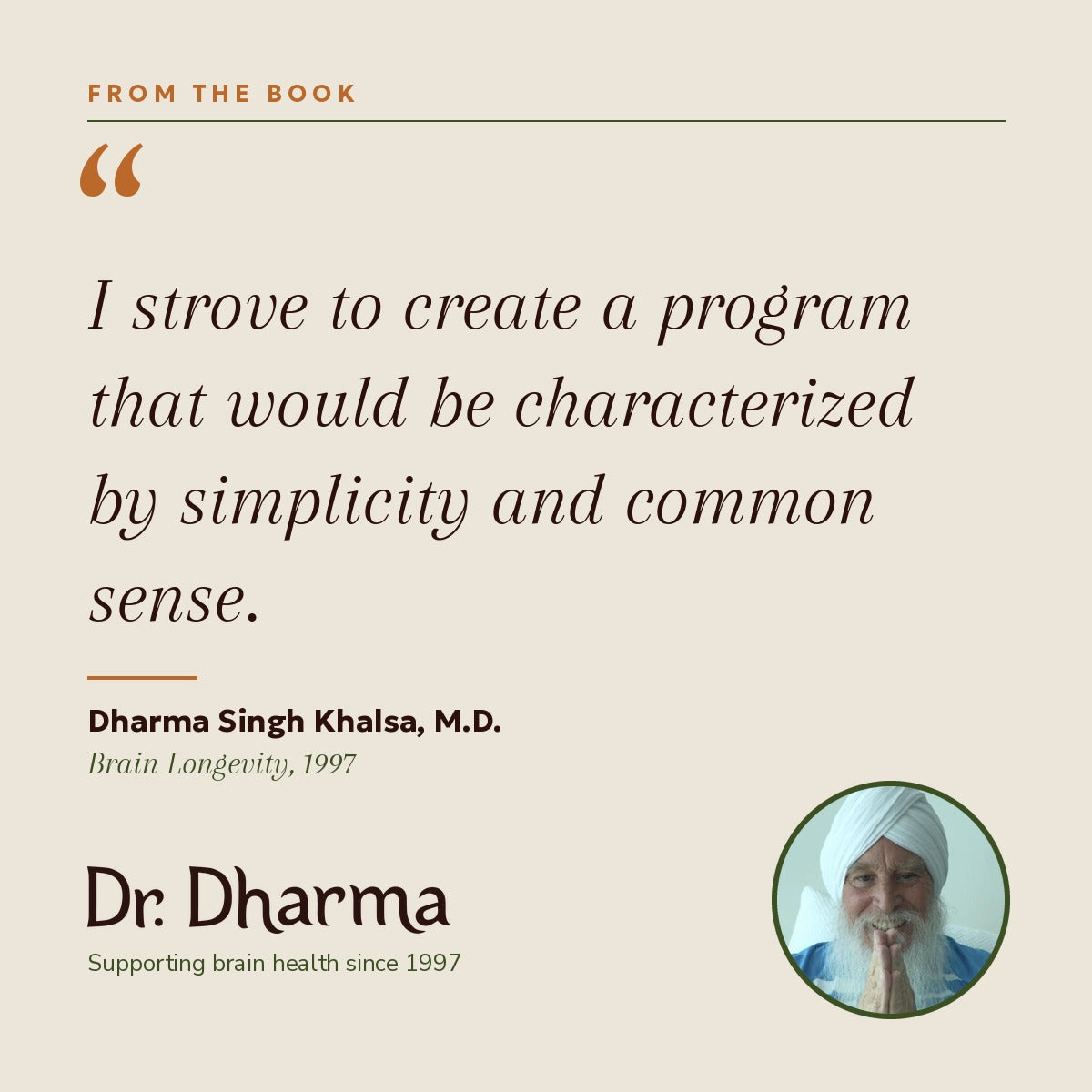
Every Tuesday this autumn, our Facebook page shares a passage from Brain Longevity, the book Dr. Dharma Singh Khalsa published in 1997. This week the passage is about how the program was built, and why it was built that way.
In Brain Longevity (1997), Dr. Dharma Singh Khalsa writes, “I strove to create a program that would be characterized by simplicity and common sense.”
Why simple
He gives the reason in the same paragraph. This was going to be a lifestyle program, not a magic bullet. So it would be run more by the patient than by the physician. “The program had to be something the average person could comprehend and coordinate,” he writes. A doctor could set the course and check on progress, but “it was up to the patients themselves to direct the daily management of their programs.”
He calls the patient-managed approach a practical necessity. He did not have time to micromanage each patient’s life. He also says it fit his view of medicine. The person living the life is the person who runs the program.
Three daily habits
He consolidated the program into four areas. Three of them are daily habits. What you eat. How you handle stress. How you move, body and mind. The fourth is medical care, and that stays between a person and their own physician.
No gadget. No menu plan. In the food chapter of Brain Longevity he is blunt about it. “I don’t want to control my patients. I want them to learn self-control, the only kind of control that ever really works, and the only kind that lasts.” The food chapter is not a set of menus but, in his words, “a group of principles,” and the principles are “simple, clear, and doable.” One of them closes with a four-word line. “Make every bite count.”
One honest day
Here is the practice we take from this passage. Common sense is easy to agree with and hard to live. So do not start with all three habits. Start with one, for one honest day.
- Pick one. Food, stress or movement. Choose the one you have been avoiding, not the one you already do well.
- Make it small enough to finish. For food, one day where every meal has something that grew in the ground. For stress, one day where you sit still and breathe slowly for twelve minutes before you look at the news. For movement, one day with a thirty-minute walk, and a crossword or a page of a hard book after it.
- Run it yourself. Nobody checks. He wrote the program for the person who lives it, not for the doctor who watches.
- Write one line at night. What you did, and whether you would do it again. That line is the start of a record.
Tomorrow, keep the habit or trade it for one of the other two. A week of honest days is a program. Not his program. Yours.
Where to go next
The free guide on our site, The Four Foundations of a Sharp Mind, is drawn from Dr. Dharma’s books. It is short, and it is free. Get the guide here.
These statements have not been evaluated by the Food and Drug Administration. This product is not intended to diagnose, treat, cure, or prevent any disease. This article is for general educational purposes and is not medical advice.