
A few quiet minutes for a clearer mind.
Short sessions in breath, movement, and meditation — designed by a physician, each with a companion guide so you can practice on your own.
Ways to begin
Wake Up to Wellness
Some mornings ask a lot of us before we've even had a chance to breathe. Wake Up to Wellness is a gentle...
Brain Energy Practice
Some mornings the mind is slow to arrive. Jumpstart Your Brain's Energy is a short, guided way to wake it up —...
Move, Breath, and Settle In
A simple, guided way to come back to yourself. Move, Breathe, and Settle In pairs gentle movement with a quiet meditation, led...
From Darkness to Light
Some seasons of life ask more of the heart than others. From Darkness to Light is a gentle, guided practice for tender...
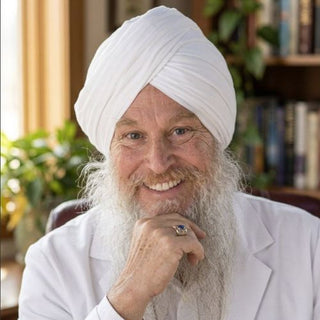
Dharma Singh Khalsa, M.D.
Board-certified physician, longevity researcher, and author of Brain Longevity. Each practice draws on the same mind-body approach he has taught for decades — simple, doable sessions that bring the body and mind back into balance.
A life of work
Not a brand with a doctor. A doctor with a body of work.
50 years
In medicine, integrative practice, and research
4 books
On the brain, memory, food, and healing
1993
Founded the Alzheimer's Research and Prevention Foundation
2003
Invited to testify before Congress
3 universities
Studied the practice at the center of his work
Every claim on this page is a matter of public record.
The practice
Twelve minutes, four sounds
At the center of his work sits one small daily practice, old enough to predate the research by centuries and simple enough to learn in an afternoon.
What it is
Kirtan Kriya is a twelve minute meditation from the Kundalini yoga tradition. It is sung on four sounds, paired with simple repeated movements of the fingers. Dr. Dharma did not invent it. He did something rarer. He asked universities to test it.
What the research found
UCLA
In a randomized trial of adults with mild cognitive impairment, Kundalini yoga with Kirtan Kriya matched the gold standard memory training on verbal memory, and outperformed it on executive function, mood, and resilience.
Lavretsky and colleagues, Department of Psychiatry, UCLA.
University of Pennsylvania
Brain imaging studies with Andrew Newberg, M.D., one of the leading researchers of meditation and the brain, documented increased blood flow in memory related regions during the practice.
Newberg and Khalsa, University of Pennsylvania Medical School.
West Virginia University
Randomized controlled trials in adults with subjective cognitive decline studied the practice against music listening, with both arms practicing twelve minutes a day.
Innes and colleagues, West Virginia University.
The Alzheimer's Research and Prevention Foundation is an independent nonprofit. It does not sell or endorse the products on this site. Research findings describe the studied practice, not any product.
His teaching
Four ideas he spent a life proving
Long before brain health was an industry, these were radical claims. He made them in books, in clinics, and before Congress, and then he helped fund the research to test them.
Food is medicine
What you eat is not fuel for the brain. It is information. He argued that diet belongs in the clinic, as a tool a doctor reaches for, decades before that idea had a conference circuit.
He wrote the book on it. Food as Medicine, 2003.
Stress ages the brain
Chronic stress is not a feeling. It is a physical force acting on memory. His clinical career was built on treating it, first in pain medicine, then in prevention.
Founding director, Acupuncture, Stress Medicine, and Chronic Pain Program, University of Arizona College of Medicine teaching hospital, 1990.
The mind trains like the body
Memory responds to practice. A twelve minute daily meditation became his most studied claim, tested in randomized trials at major universities.
Researched at UCLA, the University of Pennsylvania, and West Virginia University.
Spiritual fitness
Purpose, connection, and psychological wellbeing are not soft extras. He argues they are a measurable dimension of prevention, and he put that argument into the scientific literature.
Spiritual Fitness, Journal of Alzheimer's Disease, 2021, with Andrew B. Newberg, M.D.
Browse the collection
The Bookshelf
Each title carries a piece of three decades of work. Choose where to begin.


The Brain Kitchen
Dr. Dharma's kitchen, written down: kitchari, smoothies, and the everyday foods he cooks for a clear mind. A free recipe collection from...
$0.00

